Sectionalism
Introduction
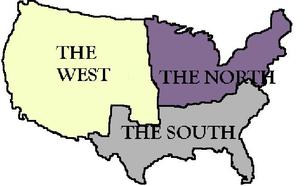
In the first half of the 19th century, the United States and its people found themselves evolving in two very different directions. That division generally reflected the geographic regions of the North and the South. As a result of their varied geography, those two regions had developed vastly contrasting economic, social, and cultural features.
The North
Rocky terrain and a short growing season produced a trade-based economy in the North. Shipping became a key industry in the mid-1800s, while Northern merchants bought and sold raw products from the South and West. In addition, manufacturing blossomed in the North as mass-production methods spread. Improving transportation and communication fostered industry by enabling factories to obtain materials and send their products over greater and greater distances.
Northern political opinions often favored the Whig Party's view of federal supremacy and leadership of the nation's economy. Northern Protestants believed that communities should set moral standards, and they supported government intervention in economic and even social issues. Many wanted, for example, to allow states to outlaw alcohol and enforce Sabbath observation. Northern Protestants also extolled the virtues of hard work and education, both of which supported urban, industrial culture.
The South
With its warm climate and fertile soil, the South welcomed agriculture. Settlers grew tobacco, rice, sugarcane, and cotton. By the 1800s, the plantation system, dependent on the unpaid labor of enslaved Africans, firmly supported this expanding agricultural economy. Plantations dominated the South, which therefore developed little industry. Most Southern trade involved the export of raw materials—largely to Northern and British textile factories—in exchange for manufactured goods.
Southern political opinions grew out of the region's cultural lifestyle. Based on rural aristocracy, with wealthy planters holding nearly all the influence, the Southern culture favored an easygoing, gracious way of life that rested on tradition. People frowned on overly eager efforts to accumulate wealth and viewed Northern bankers as corrupt. They also opposed the idea that government, or anyone else, should dictate morality or regulate banking and trade. Southerners cherished their history and faced the nation's rapid modernization and industrialization with suspicion.
Civil War Looms
Sectionalism grew increasingly pronounced during the first half of the 19th century as slavery arose as a hot-button issue. Southerners defended their way of life by justifying slavery on Biblical grounds. Hoping to gain access to fresh lands, they also pushed for the expansion of slavery into new territories. Northerners increasingly disapproved of slavery on moral grounds and disliked the South's headstrong attitude toward the federal government. They worked against the expansion of slavery into new territories. Those issues festered alarmingly as the nation lurched toward war.
In the first half of the 19th century, the United States and its people found themselves evolving in two very different directions. That division generally reflected the geographic regions of the North and the South. As a result of their varied geography, those two regions had developed vastly contrasting economic, social, and cultural features.
The North
Rocky terrain and a short growing season produced a trade-based economy in the North. Shipping became a key industry in the mid-1800s, while Northern merchants bought and sold raw products from the South and West. In addition, manufacturing blossomed in the North as mass-production methods spread. Improving transportation and communication fostered industry by enabling factories to obtain materials and send their products over greater and greater distances.
Northern political opinions often favored the Whig Party's view of federal supremacy and leadership of the nation's economy. Northern Protestants believed that communities should set moral standards, and they supported government intervention in economic and even social issues. Many wanted, for example, to allow states to outlaw alcohol and enforce Sabbath observation. Northern Protestants also extolled the virtues of hard work and education, both of which supported urban, industrial culture.
The South
With its warm climate and fertile soil, the South welcomed agriculture. Settlers grew tobacco, rice, sugarcane, and cotton. By the 1800s, the plantation system, dependent on the unpaid labor of enslaved Africans, firmly supported this expanding agricultural economy. Plantations dominated the South, which therefore developed little industry. Most Southern trade involved the export of raw materials—largely to Northern and British textile factories—in exchange for manufactured goods.
Southern political opinions grew out of the region's cultural lifestyle. Based on rural aristocracy, with wealthy planters holding nearly all the influence, the Southern culture favored an easygoing, gracious way of life that rested on tradition. People frowned on overly eager efforts to accumulate wealth and viewed Northern bankers as corrupt. They also opposed the idea that government, or anyone else, should dictate morality or regulate banking and trade. Southerners cherished their history and faced the nation's rapid modernization and industrialization with suspicion.
Civil War Looms
Sectionalism grew increasingly pronounced during the first half of the 19th century as slavery arose as a hot-button issue. Southerners defended their way of life by justifying slavery on Biblical grounds. Hoping to gain access to fresh lands, they also pushed for the expansion of slavery into new territories. Northerners increasingly disapproved of slavery on moral grounds and disliked the South's headstrong attitude toward the federal government. They worked against the expansion of slavery into new territories. Those issues festered alarmingly as the nation lurched toward war.
